
Menu
Highlights of Nepalese Labor Laws
Highlights of Nepalese Labor Laws
This Article provides all basic understanding and outline of Labor Act 2017, Labor Regulation 2018 of Nepal.
1. Introduction
In Nepal, the Labor Act 2074 acts and governs the labor relations between employees and the employer in the country where it covers the overall aspects of working conditions, leave provisions, allowance allotment, work permits for foreign nationals, sanctions and many more.
2. Employment Contract
- An employee cannot perform any duties without having an employment contract. There should be a written employment contract for all employees but casual employees are not required to have an employment contract.
3. Basic Terms Included in Labor
- No discrimination against any employee based on color, religion, sex, caste or other similar factors.
- Prohibition on the employment of children
- Equal remuneration to equal work without discrimination based on gender.
- Right to trade union
- Right of employees to seek remedies for violations of their rights.
- Prohibition on employing in forced labour.
4. Types of Employment
As per article 10 of the Labor Act, 2074, there are basically 5 types of employment;
- Regular employment,
- Time-based employment,
- Work-based employment,
- Part-time employment
- Casual employment
1. Regular Employment
Stable, regular ongoing work with consistent hours and benefits
2. Time-Based Employment
Employment that the employer provides or has provided to the labour specifying a certain period on the condition that the labour has to provide any service or perform any work within that period.
3. Work-Based Employment
Employment of specific particular work or service for performance.
4. Part-Time Employment
Employment with a weekly work requirement of 35 hours or less.
5. Casual Employment
Employment with a work requirement with a 7 days or less per month.
5. Labor Law is Applied Only to the Following Entities
Applicability
Labor Act is only applicable in the following entities:
1. Company;
2. Private firm;
3. Partnership;
4. Cooperatives;
5. Associations or other organizations;
6. Entities registered in foreign countries and engaged in the promotion of business, sale of products, or promotion of other works in Nepal.
6. Provisions relating to Social Security Fund in Nepal
The Labor Act has introduced the provision relating to the Social Security Fund(“SSF”). Subsequently, the Social Security Act, 2017 and the Social Security Regulations, 2018 were enacted for the establishment and operation of SSF. The following percentage amount from the basis salary shall have to be deposited by the employer and employee in SSF.
| Particulars | Employer | Employee | Total |
| Provident Fund | 10% | 10% | |
| Gratuity | 8.33% | – | |
| Social Security Tax | – | 1% | 31% of basic salary |
| Medical Insurance | 1.67% | – | |
| Total | 20% | 11% |
7. Process of Obtaining Foreign Labor Work Permit in Nepal
In Nepal and as per Nepalese Labor law, no any foreigner can access to work without getting work permit from the related department. Foreign citizens working in Nepal, except those with diplomatic immunity or exempt under treaties must acquire a work permit. Procedures as to how foreigners get the work permit are listed below:
Step 1: Firstly, advertisement to be given by employer in a national newspaper to hire skilled Nepali citizens
Step 2: In case if no any Nepali citizen applies for employment, the employer shall ask for work permit of a foreign employee from the labor department.
Step 3: Application to the Department of Labor
Step 4: No objection to be granted by Ministry of Home Affairs upon request by the Labor Department.
Step 5: Issuance of work permit for skilled foreign labor upon maintaining the record and after reviewing all the application and evidence by the department.
Work permit is granted to following foreign employees in specific circumstances as:
- The chief executive of a foreign funded enterprise and the required labor
- Technicians for short-term repair, maintenance or installation for up to 3 months .
8. Validity of Work Permit for Foreign Employees
- The work permission duration shall not exceed as mentioned in the Ministry of Home Affairs consent letter.
- 2 years extension of work permit in special cases upon approval from Ministry for those benefiting national interest, welfare, education, science and technology.
- 5 years work permit for experts and others for 3 years
- Renewal of work permit before 30 days upon their expiration.
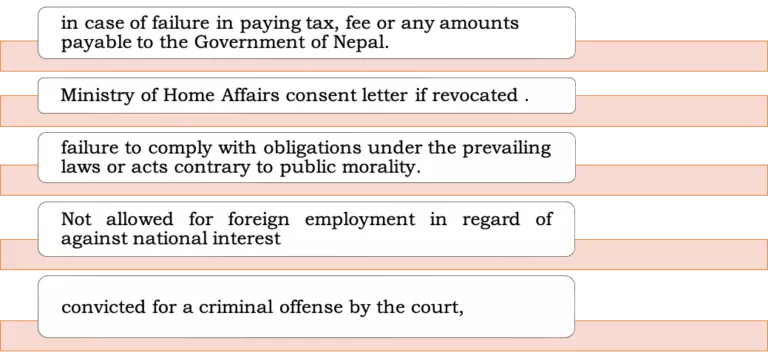
9. Cancellation of work Permit of Foreign Employee
The work permit gets cancelled in the following ways:
10. Working Hours as Provisioned in Labor Act Nepal, 2074
| Maximum working hours | 8 hours a day and 48 hours a week half an hour rest after five hours of continuous work. | |
| Overtime working hours | 4 hours a day and 24 hours a week |
|
| Break | 30 minutes break after consecutive 5 hours of work |
|
| Additional Break | additional 30-minute break for pregnant female employees and female employees with a child below 3 years of age. |
11. Provisions Relating to Leave
As per Labor Act, 2074:
| 1. | Weekly leave | For 1 day in each month |
| 2. | Public leave | Annually 13 days paid leave
14 days for female employees, including International Women's Labour Day. In case for enterprises, leave set by the regulatory authority or by employer. |
| 3. | Substitute leave | In case of continuous regular work, substitute leave for weekly or public holidays worked.
Within 21 days for employees working on a weekly or public holiday |
| 4. | Home leave | 1 day of paid home leave for every 20 days of working
Employees of educational institution who gets summer/winter leave cannot get home leave but if leave is shorter than home leave, then can get the shorter leave duration as home leave |
| 5. | Sick leave | 12 days of paid sick leave annually; employees working for less than a year gets sick leave proportionally
Beyond 3 days sick leave, a doctor’s certificate is required Must inform the employer in case of sudden illness |
| 6. | Maternity leave | 14 weeks of maternity leave for pregnant women
Leave before 2 weeks of delivery and after 6 weeks of delivery Full pay for 60 days of maternity leave, afterwards no pay Upon recommendation of doctor for more rest, unpaid leave for additional 1 month is given or adjusted with maternity leave Leave as for a normal delivery for a late miscarriage employee Paid leave for father if a mother dies within 60 days of childbirth 15 days of paid maternity leave for male employee for his wife’s care during childbirth.
Note: A female employee on maternity leave has to provide the employer with a birth registration certificate, except in cases of a child’s death. |
| 7. | Mourning leave | 13 days of leave for mourning in the death of a family member
Full pay on mourning leave |
12. Provision Based on Accumulation of Leave
- Home leave up to 90 days
- Sick leave up to 45 days
- An employee with leave exceeding the specified period shall receive pay for the excess a the end of each year based on their basic remuneration
- Employee or the concerned family member to receive a lump sum based on the last drawn basic remuneration for accumulated home and sick leave upon termination or death of employee.
To be noted: Except sick leave, maternity leave and mourning leave, all other leaves are considered as facility which cannot be claimed as a matter of right
13. Allowance as Provisioned in Labor Act, 2074 Nepal
- Minimum salary: As recently published in Nepal Gazette, the minimum salary is Rs. 17,300( including basic salary of Rs. 10,820 and dearness allowances of Rs. 6,480)
- Annual Increment: At least half a day’s basic salary
- Festival Allowance: 1 month’s basic salary per year
- Deduction from salary: deduction of tax as per the prevailing laws, contribution amount for social security, salary for absence from work, etc.
- Reserve Period: half the salary during such period
14. Misconduct and Disciplinary Action
As as labor act, 2074, Nepal, the following are some of the misconducts and the punishment for those misconducts:
15. Misconduct and Punishment
Misconducts where the employee may be reprimanded:
a. Unauthorized work absence.
b. Leaving workplace without permission
c. late in work without obtaining permission,
d. disobeying work orders from employer or superiors
Remuneration equal to a maximum of one day may be deducted:
a. To refuse to receive any letter or notice given by the employer or sentencing authority
b. To take part in an illegal strike or force others to do so or make delay or slow in work collectively
c. To cause loss or damage to the enterprise by decreasing the production or service recklessly or negligently
d. To make attempt to take benefits by submitting false documents,
e. To not use the equipment provided by the employer if he or she is a labour responsible for using such equipment,
Annual salary increment of one year may be withheld or promotion withheld for one year:
a. To take any property outside the enterprise without the permission of the competent person and use it or allow it to be used by any unauthorized person,
b. To make attempt to make embezzlement in the employer’s transaction,
c. To damage the employer’s property recklessly or negligently,
d. To stop the supply of food, water, telephone, electricity service or prevent movement within the workplace,
e. To intentionally misuse, or cause loss or damage to any goods kept or provisions made for the benefit, safety or health of the labours,
Termination of employment
a. If it causes bodily injury, hostage of the employer, employee, or any person in the workplace
b. Giving and taking bribes
c. Making financial misappropriation in the workplace
d. Causing damage to any property that belongs to the employer,
e. Remain absent from work for more than thirty consecutive days without having a leave sanctioned,
f. If not maintained the secrecy of any confidential matters of the workplace with the intention of causing loss or damage to such an enterprise,
g. Conviction by the court of any criminal offense involving moral turpitude
h. To make and submit any fake educational certificate and other certificate for the purpose of appointment,
i. Consuming narcotic substance or liquor during the working hours or presence in workplace upon consuming it
j. Commission of any misconduct if the law provides for the dismissal from service in the case of commission of such misconduct.
Sexual harassment
- The employment of the employee committing sexual harassment may be terminated depending upon the situation and seriousness of the offence.
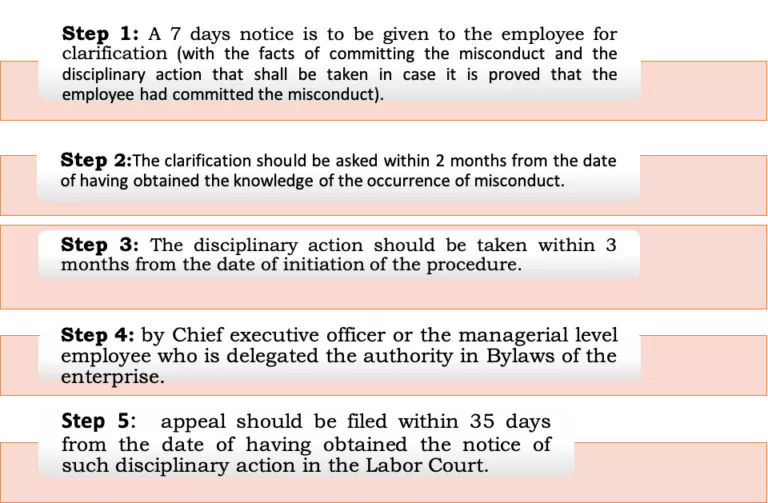
16. Procedure for Disciplinary Action for Employee by Employer
Disciplinary Action procedure for employee for their misconduct is given below:
17. Sanctions for Non-Compliance of as Per the Labor Law of Nepal
The Labor Act provides the sanctions which includes fine, imprisonment and both for violation of the provision of the Act. Labor Court, Labor Department and Labor Office has authority to impose the sanction depends on the nature of violation which as listed in below paragraph.
a. Sanction by Labor Department
The Labor Department conducts necessary inquiry into a complaint made on any of following matters and imposed the mentioned sanction in case of non-compliance:
| Non-Compliance | Consequences of Non-Compliance |
| The person who supplies labors without obtaining any license and any person that hires and employs labors through such a labor supplier. | Compensation not exceeding NPR 200,000. |
| The person who employs a foreigner without obtaining the labor permit. | On the basis of the number of such labors, a fine shall not exceed NPR 200,000. If the same misconduct is repeated, then an additional fine of NPR 5,000 per person per month. |
| The person who discriminates labor at the time of employment or during employment. | Fine not exceeding NPR 100,000 and an order to maintain equality. |
| The persons who employ a labor without giving an appointment letter or without entering into an employment contract. | Fine not exceeding NPR 500,000 at the rate of NPR 10,000 per labor. An order can be provided to conclude an employment agreement and provide an agreement letter. |
b. Sanction by Labor Office
The Labor Office does necessary inquiry into a complaint made on any of following matters and imposed the mentioned sanction in case of noncompliance:
| Non-Compliance | Consequences of Non-Compliance |
| Deduction of remuneration or benefits contrary to this Act or rules framed under this Act. | Indemnify the concerned worker with an amount double the deducted remuneration and other facilities. |
| Obstructing or hinders a government employee by submitting false description. | Fine not exceeding NPR 200,000. |
| Employer, who engages any person as an intern against the provision of Labor Act. | Fine at the rate of NPR 10,000 per intern or trainee. |
| Failure to deposit the gratuity amount or in the provident fund or Social Security Fund or to arrange medical or accidental insurance. | Indemnify the worker with an amount double the amount to be paid. |
| Employers who make retrenchment contrary to this Act or in a discriminatory manner. | Refrain from doing so. |
| Terminating employment from attending work contrary to this Act. | Issue necessary dire |
c. Sanction by Labor Court
The Labor Court does necessary inquiry into a complaint made on any of following matters and imposed the mentioned sanction in case of noncompliance:
| Non-Compliances | Consequences of Non-Compliance |
| If any person engages anyone in forced labor. | Imprisonment for a term not exceeding 2 years or a fine not exceeding NPR 500,000 or both and require such a person to pay remuneration, allowance, and benefit including damages double of such amount. |
| If any entity does not make health and safety arrangements knowingly and as a result, the worker dies or suffers physical or mental injuries. | Imprisonment not exceeding and pay appropriate compensation to the aggrieved party. |
Disclaimer: All content available here is for general information purposes. A proper legal solution always depends on your particular circumstances thus seek advice from an attorney who can provide assurances of the information contained herein and its interpretation of it. All liability with respect to actions taken on the basis of the site’s information is hereby expressly disclaimed.
For quick legal assistance:
You can directly call to our legal expert: +9779841933745
Even can call or drop a text through What's app , Viber, Telegram and We Chat at the same number.
Also can do email on : info@lawinpartners.com
Get in Touch with Our Legal Experts
Have a question or need legal assistance? Fill out our contact form and our team of experienced lawyers in Kathmandu, Nepal will get back to you promptly.
Please include your WhatsApp or Viber number in the phone section if you'd prefer a direct call from one of our legal professionals.
We are here to provide trusted legal support tailored to your needs.
Phone : +9779841933745, +9779841933745
REACH OUT TO US AT ANY TIME
More Publications